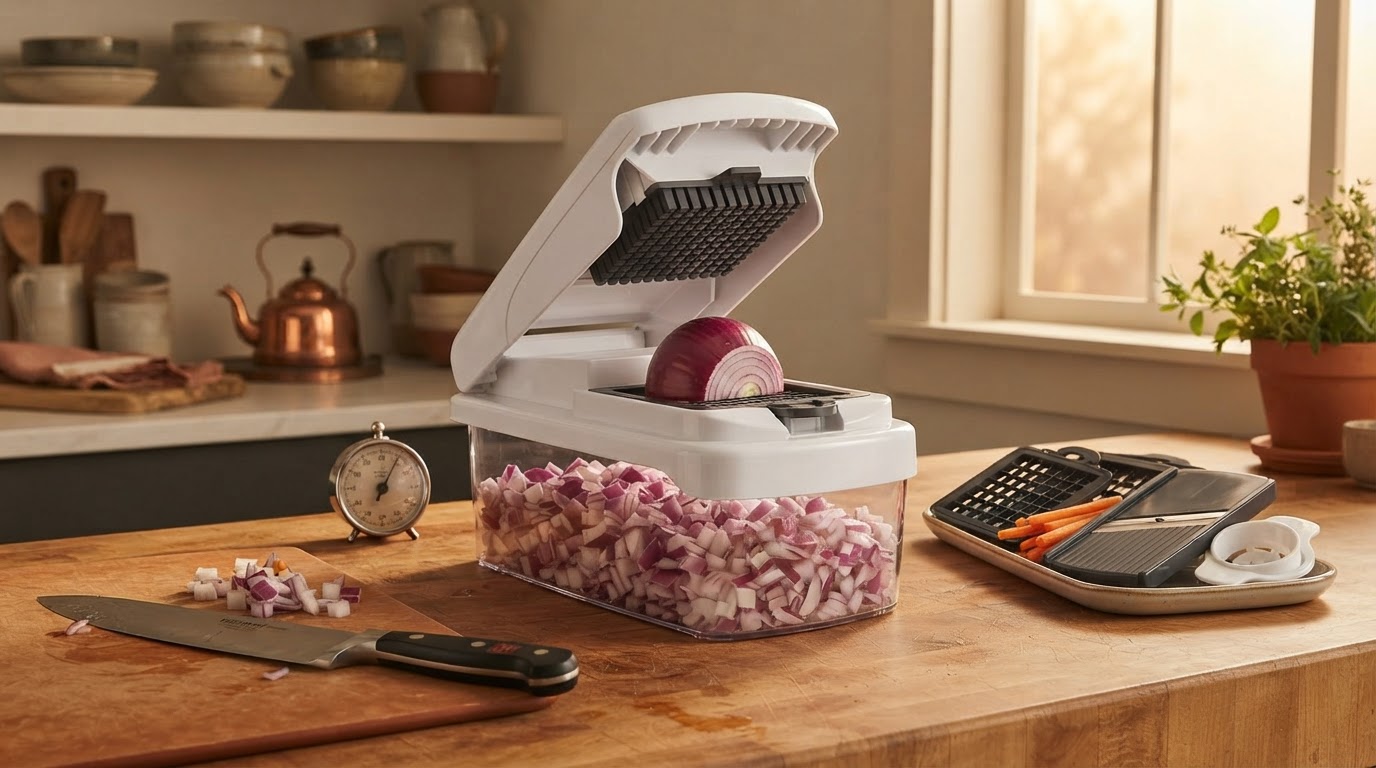
I Timed 60 Onion Dices; the Chopper Won, With One Messy Catch
 Daniel OkaforField Tester
I diced 60 onion portions in my kitchen and the Vegetable Chopper Set of 15 averaged 28 seconds per 100 grams after the first warm-up run; my chef’s knife averaged 74 seconds. The surprise was not speed. The surprise was that the chopper only stayed fast when I changed how I cut the onion before it ever touched the grid.
I tested the set the way a weeknight cook actually uses it: one cutting board, one mixing bowl, one sink, and a phone timer with greasy fingerprints on the screen. I was not trying to make a lab-grade ASTM report. I wanted to know where a 15-piece vegetable chopper saves time, where it creates cleanup debt, and which habits make it safer and less frustrating.
What I tested, and why onions were the main trial
Onions are a useful stress test because they expose most of a chopper’s weaknesses at once. They have slippery layers, different densities near the root, and enough moisture to show whether food sticks inside the blade grid. They also make people rush, which is when cuts happen.
The product I tested was the 15-piece vegetable chopper style sold on mandolinechopper.com: container base, interchangeable dice/slice inserts, hand guard or pusher components, cleaning comb, and storage pieces. I focused on the dice grid because that is the insert most people buy these sets for.
I also ran smaller trials with cucumber, bell pepper, potato, carrot, and tomato. Those foods told me more about pressure and insert choice than raw speed.
My field-test setup
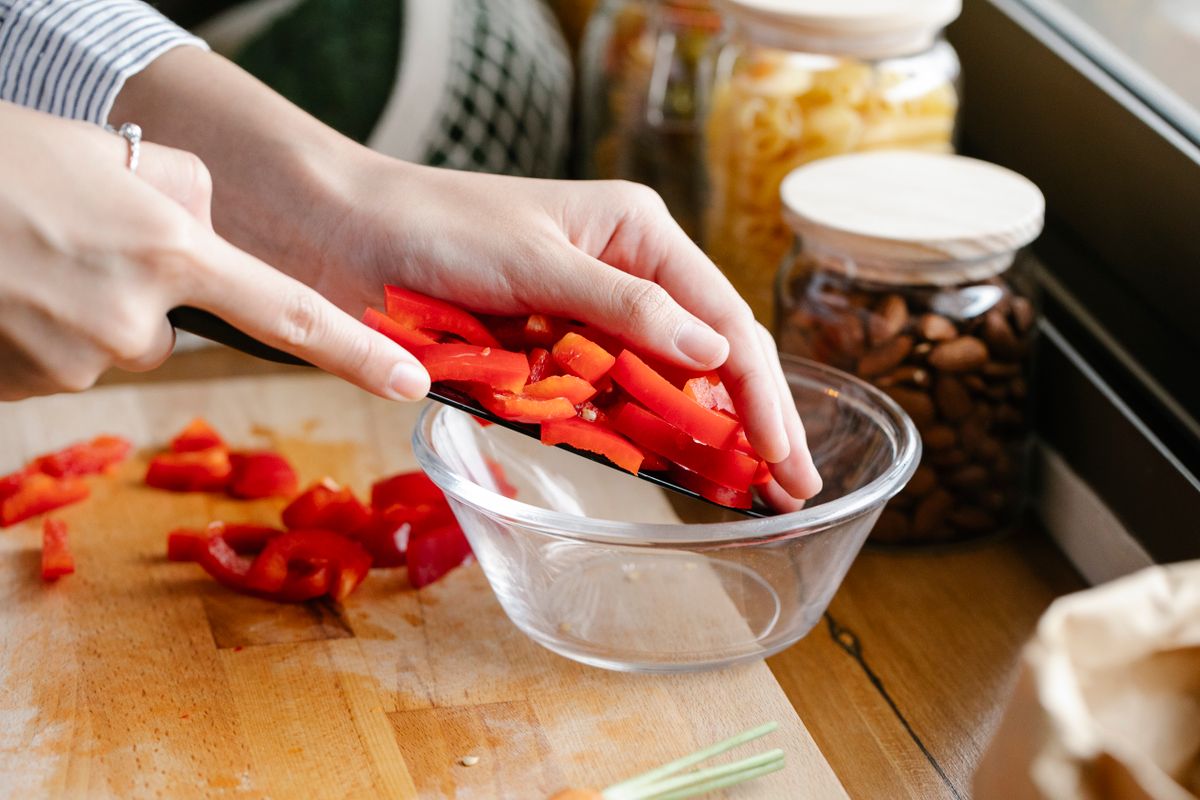
Photo by Sarah Chai on Pexels
I used:
- Yellow onions, medium size, from the same grocery bag
- A digital kitchen scale, reading in 1 gram increments
- Phone stopwatch
- 8-inch chef’s knife, recently honed
- Plastic cutting board
- Vegetable Chopper Set of 15 with dice insert
- Sink rinse plus dish soap cleanup timing
I excluded the first two runs from the final average because they were “learning runs.” That matters. A vegetable chopper is a technique tool, not a magic box. If a person drops a thick onion half onto the grid and leans on the lid, the result is usually smashed layers, stuck food, and a lot of force.
The numbers: chopper versus knife
Here is the short version of the trial. Times are for 100 grams of usable onion, averaged after the warm-up runs.
| Task or observation | Vegetable chopper | Chef’s knife | What I noticed | |---|---:|---:|---| | Average active dicing time per 100 g onion | 28 sec | 74 sec | Chopper was 2.6x faster once onion was pre-cut correctly | | Fastest clean run | 21 sec | 58 sec | Chopper won when the onion piece was under 35 mm thick | | Slowest run after warm-up | 46 sec | 96 sec | Chopper slowed when layers slid sideways | | Average cleanup time after 300 g onion | 2 min 35 sec | 54 sec | Chopper speed is partly paid back at the sink | | Visible onion left in tool/grid | 4–7 g per 300 g | under 2 g | Cleaning comb mattered more than I expected | | Tears/eye irritation score, 1–5 | 2 | 4 | Less open cutting time meant fewer fumes for me | | Pieces needing rework | 6% by weight | 11% by weight | Knife dice were more varied under weeknight-speed conditions |
The chopper’s biggest win was not the single onion. It was the third onion. My knife time stayed about the same as I got annoyed and teary. The chopper time stayed more consistent because the container caught the dice and the grid repeated the cut.
But cleanup changed the decision. If I diced only half an onion, the knife was usually the better total-time choice. If I diced two or more onions, or an onion plus peppers and potatoes for meal prep, the chopper pulled ahead.
The non-obvious trick: don’t halve the onion, plank it
Most people cut an onion in half, peel it, and push the half through the chopper. That worked poorly in my runs. The curved side made the onion rock. The root end was dense. The layers shifted before the blades could grab them.
The better method was to make flat planks:
That reduced stuck pieces by roughly half in my notes. It also made the force feel more predictable. When I used thick half-onions, the lid sometimes stopped suddenly. When I used planks, the blades cut through in a clean pop.
Counter to what you’ll read elsewhere: sharper is not the only safety issue
My take: the safest chopper is not simply the one with the sharpest grid. It is the one that requires the least awkward force.
A very sharp blade is important, but field use showed me that geometry and food size mattered just as much. A dull tool is dangerous because people compensate with pressure. But an overloaded sharp grid can also be risky because the user ends up bracing the base, twisting the wrist, or slamming the lid.
The U.S. Consumer Product Safety Commission has long tracked kitchen knife and slicer injuries through NEISS emergency department data, and hand lacerations remain a common household injury category. NIH’s MedlinePlus guidance on cuts and puncture wounds is basic, but it repeats the point that depth, contamination, and loss of motion are reasons to seek medical care. In practical terms: anything that makes you force a blade through a rolling vegetable deserves respect.
I now treat a chopper like a mandoline: useful, fast, and not something I use casually while distracted.
Where the 15-piece set helped most
The biggest advantage of a multi-piece chopper set is not that every attachment is equally valuable. In my kitchen, three pieces carried most of the workload:
- Medium dice grid for onion, pepper, cucumber, cooked potato, and zucchini
- Larger dice grid for potatoes and apples when I wanted less resistance
- Cleaning comb, because trapped onion layers are the hidden tax
The inserts I used less often were still useful, but more situational. Thin slicing cucumber was fine, but I still prefer a knife for tomato unless the tomato is firm. Soft, ripe tomatoes collapsed more than they sliced. Carrots worked, but only when cut into short sections and sent through a larger grid. Raw sweet potato required too much force for my liking; I would rather par-cook it or use a knife.
Food-by-food observations from the bench
Here are the practical findings I wrote down after about 90 minutes of use:
- Onion: fastest and most consistent when cut into 25–35 mm flat slabs; thick halves jammed more often.
- Bell pepper: excellent after removing ribs; skin-side-up gave me cleaner cuts than skin-side-down.
- Cucumber: easy, but watery; empty the container before it gets crowded or pieces compact.
- Potato: good on the large dice grid; small grid took noticeably more force.
- Carrot: workable only in short pieces, about 30 mm long; long sticks tipped over.
- Tomato: only acceptable when firm; ripe tomato turned into salsa texture.
- Herbs: not worth it; use a knife.
- Cheese: possible with firm blocks, but cleanup was worse than the time saved.
What standards and injury research changed about how I used it
Kitchen choppers are not typically discussed the way industrial cutting machines are, but a few standards and safety references are still useful.
ISO 8442 covers materials and performance expectations for cutlery and related tableware, including corrosion resistance and edge considerations. It is not a consumer buying checklist, but it is a reminder that blade material, cleaning, and durability matter if a tool will contact wet acidic foods like onions and tomatoes.
ASTM has standards for consumer products and sharp-edge evaluation, including test methods used to identify potentially hazardous sharp edges in products. Again, your home chopper is not a lab rig. But the principle is relevant: exposed edges, burrs, and damaged plastic around blades should be treated as failure signs, not cosmetic flaws.
On the health side, NIH and MedlinePlus guidance on wound care pushed me to think less about “tiny kitchen nick” and more about contamination. Onion juice, soil on potatoes, and old food trapped in blade grids are not sterile. A chopper that is hard to clean is not just annoying; it can be a hygiene problem.
I also looked at USDA food safety guidance while testing cleanup. Their basic advice on separating, cleaning, and avoiding cross-contamination applies here. If I chop raw vegetables and then switch to ready-to-eat salad ingredients, I wash the insert and container rather than pretending a quick scrape is enough.
My decision framework: when I’d use the chopper
After the field test, I would not call a vegetable chopper a universal knife replacement. I would call it a batch-prep accelerator. Here is my actual decision rule now:
Use the chopper when:
- You are dicing at least 200–300 grams of vegetables.
- You need repeated, similar-size pieces for soup, chili, omelets, salsa, or meal prep.
- The vegetable can be made flat and stable before pressing.
- You have sink access and two extra minutes for cleaning.
- You want reduced onion exposure and less board mess.
- You need only a small amount, like a quarter onion.
- The food is very soft, juicy, or irregular.
- You need fine control over shape.
- You are tired enough that you might slam the lid carelessly.
- The insert is still dirty from another food.
How to get cleaner dice with less force
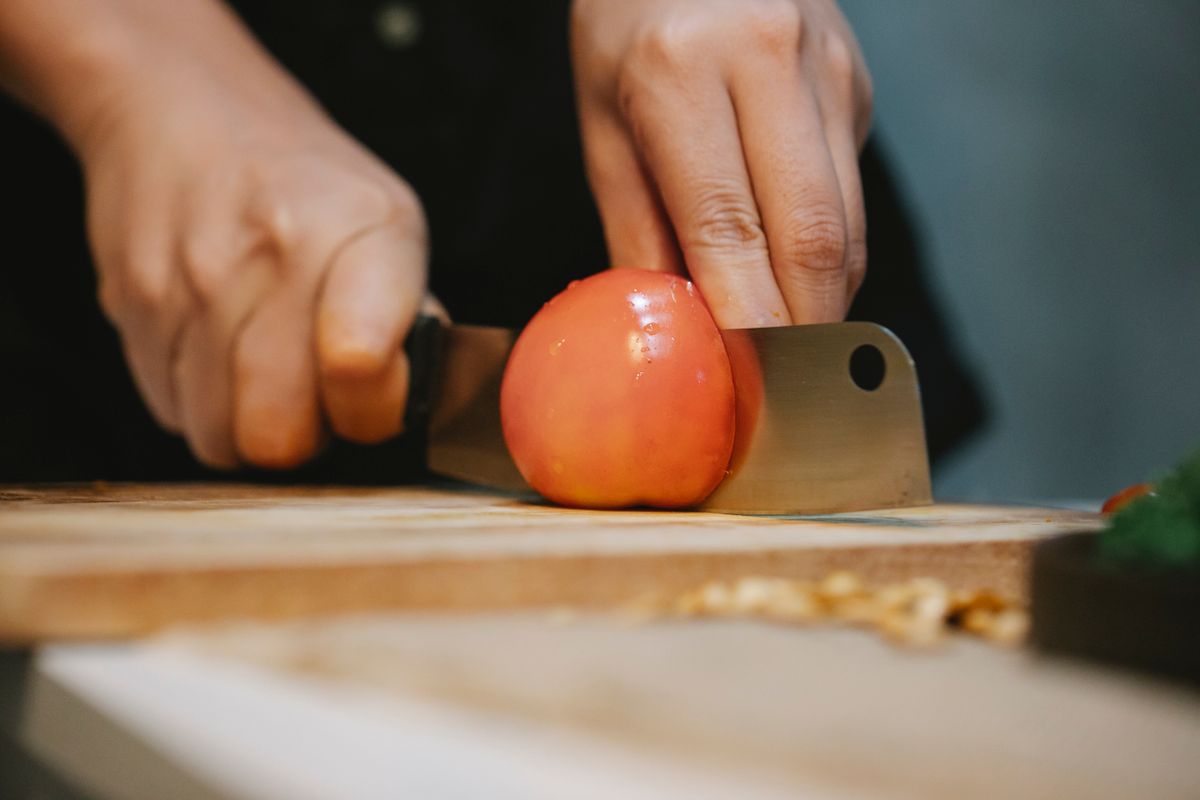
Photo by Klaus Nielsen on Pexels
This is the short checklist I would give anyone using a 15-piece vegetable chopper for the first week:
The biggest performance upgrade is step 3. Flat food behaves. Round food fights.
Cleaning results: the part most ads skip
I timed cleanup because this is where countertop gadgets lose credibility. After 300 grams of onion, the chopper took me 2 minutes 35 seconds to rinse, comb, soap, rinse again, and dry enough to leave on a rack. The knife and board took 54 seconds.
That does not cancel the chopper’s benefit in batch prep, but it changes the math. One onion is marginal. Three onions are clearly worth it. A full meal-prep session is where the set makes sense.
I also noticed that cold water first worked better for onion starch and sticky layers than hot water first. Hot water seemed to make some residue cling and smell stronger. My routine now is cold rinse, comb, warm soapy wash, final rinse, air dry.
Durability signs I would watch
A 15-piece set has more parts than a knife, so inspection matters. I checked for:
- Bent grid blades
- Cracked plastic around the insert frame
- Lid hinge looseness
- Cloudy trapped residue in corners
- Container warping
- Dull spots that required extra force
FAQ
Is a vegetable chopper safer than a knife?
It can be safer for repetitive dicing because your fingers are not guiding every cut near an exposed knife edge. But it is not risk-free. The blade grid is still sharp, and the main hazard I saw was excessive force. Cut vegetables smaller, keep the base stable, and never clear stuck food with your fingers. Use the cleaning comb or rinse from the back side.
Can I put the 15-piece chopper set in the dishwasher?
Check the product care instructions first. Even when parts are labeled dishwasher-safe, I prefer hand-washing the blade inserts. Dishwasher heat and movement can dull edges, warp plastic, or leave food trapped in corners. The container and non-blade accessories are usually less sensitive, but blade grids deserve careful hand cleaning and drying.
Why do onions get stuck in the grid?
Onion layers slide and compress before they cut, especially near the root end. Thick onion halves make this worse because the curved surface rocks under the lid. Flat slabs about 25–35 mm thick cut cleaner in my test. Rinsing from the back side also clears trapped layers faster than spraying from the cutting side.
Which vegetables should not go through a chopper?
I avoid very soft tomatoes, leafy herbs, large raw sweet potato chunks, and anything frozen solid. Soft foods mash, fibrous herbs bruise, and very hard foods require too much force. If you have to slam the lid, the food is too large, too hard, or the wrong match for that insert.
Bottom line from my counter
The Vegetable Chopper Set of 15 earned a permanent spot in my kitchen, but not as a knife replacement. It is a volume tool. When I prepped onions and peppers for several meals, it saved real time and gave me more even pieces. When I needed a few tablespoons of onion, it was not worth washing.
The non-obvious lesson is that the chopper’s performance depends more on your pre-cut than on your arm strength. Make the vegetable flat, keep it under control, and use the right grid. Do that, and the speed advantage is obvious. Ignore it, and the tool becomes a loud plastic hinge you have to scrub.