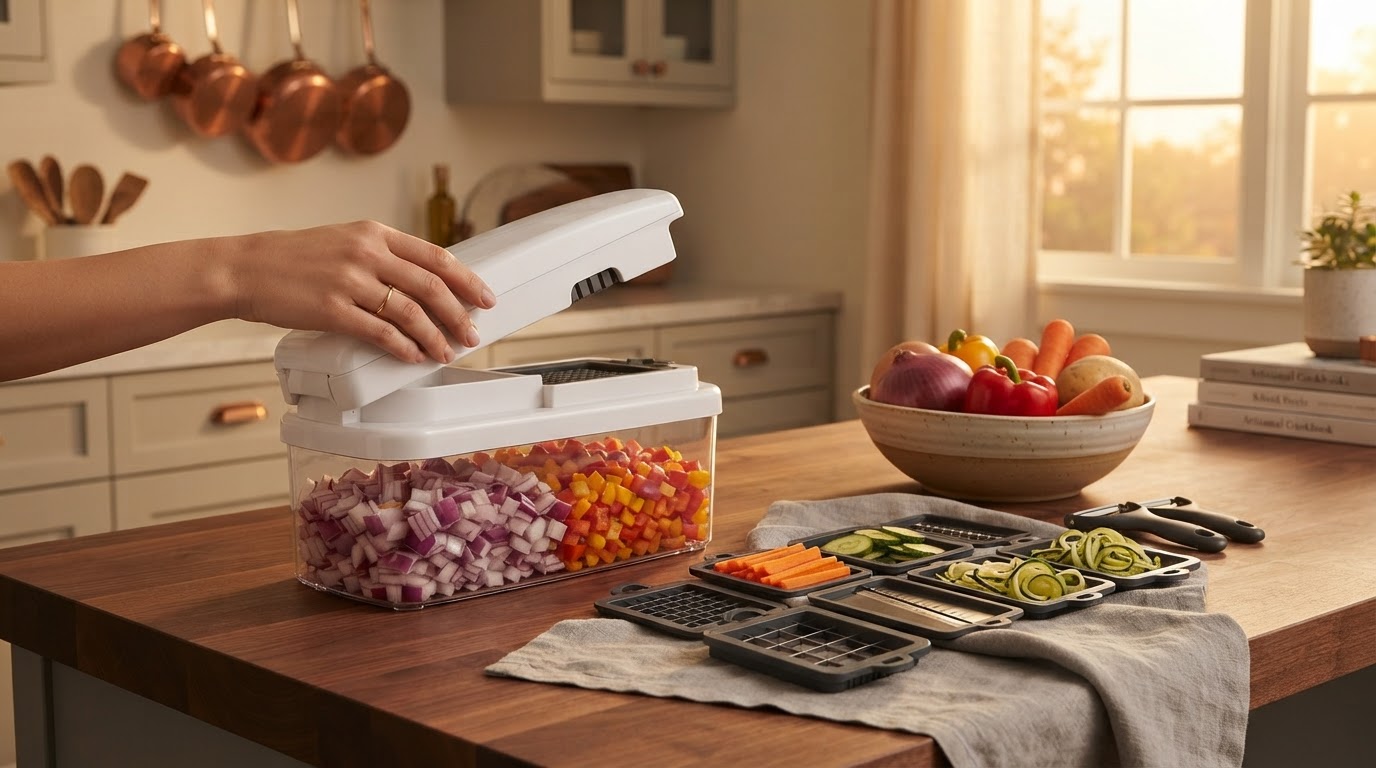
The 2-cup rule for buying a 15-piece vegetable chopper
 Maya ChenContributing Editor
A 15-piece vegetable chopper starts to beat a knife at about 2 cups of firm vegetables—not because it is magically faster at cutting, but because it removes the slowest part of weeknight cooking: repeated decisions about size, shape, and cleanup sequence.
That is the part most product reviews miss. They time one onion, declare victory, and ignore the bowl, lid, insert swap, food transfer, hand washing, counter wipe, and the tiny pile of onion trapped under the grid. I care less about the heroic 12-second dice than the full trip from whole vegetable to pan-ready food.
I sell and test kitchen tools around a blunt truth: a chopper is not a knife replacement. It is a batch-prep machine. If you use it like a knife, you will be disappointed. If you use it like a small, manual prep station, the value becomes obvious.
The category mistake: buyers compare blades, not workflow
Most shoppers ask, “Is a vegetable chopper sharper than my knife?” Wrong question.
The better question is: How many repetitive cuts can I remove before the tool becomes more annoying to wash than the knife was to use?
That matters because cooking is not a knife-skills contest. It is a chain of friction points: finding a board, trimming the vegetable, cutting stable flats, dicing evenly, moving food to a bowl, washing surfaces, and doing it again tomorrow. A chopper set with multiple inserts, a catch container, and accessories wins only when it compresses that chain.
The Vegetable Chopper Set of 15 on mandolinechopper.com is built for that middle zone: weekday salsa, omelet vegetables, soup base, salad add-ins, stir-fry prep, and batch chopping for two or more meals. It is overkill for one radish. It is underappreciated for three onions, two peppers, carrots, cucumber, and a container of tomorrow’s lunch.
My measured kitchen observation: the knife wins small jobs
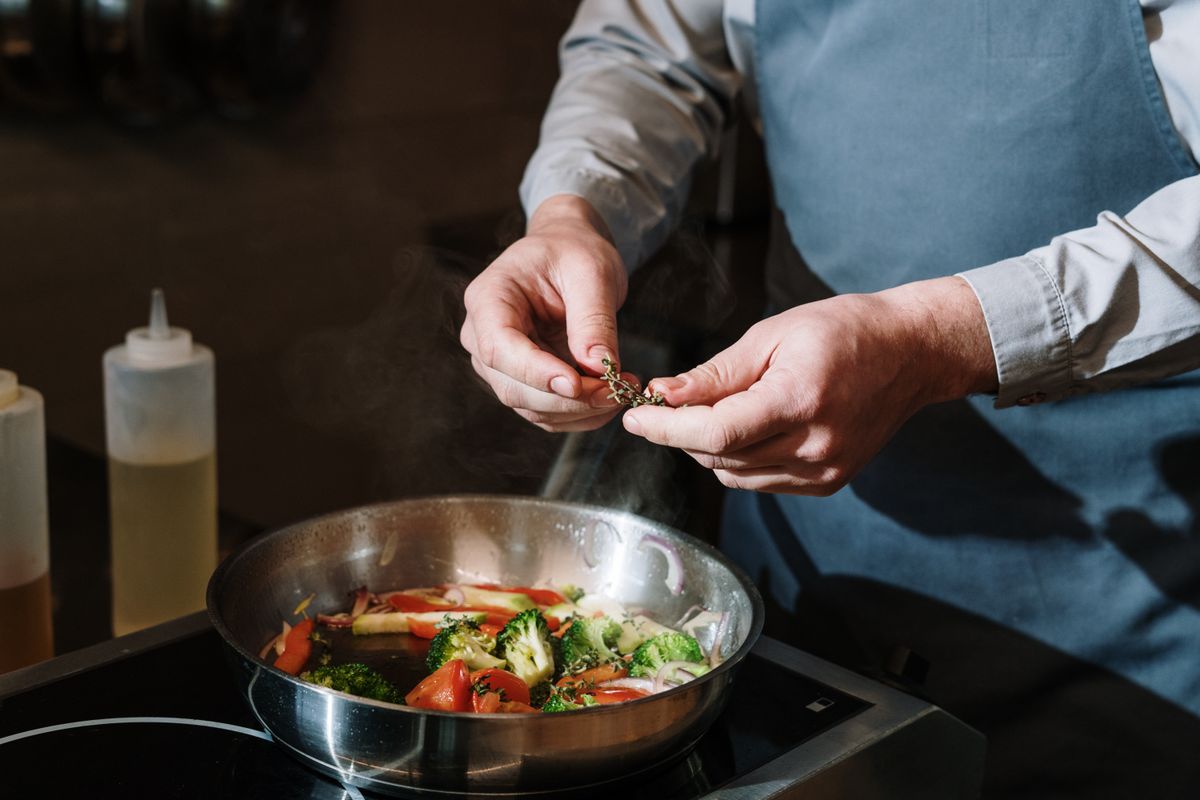
Photo by cottonbro studio on Pexels
I ran a simple home-kitchen timing check, not a lab trial: same counter, same cutting board, same bowl, vegetables trimmed first, stopwatch started when the first cutting motion began and stopped when the food was ready for the pan or storage container. Cleanup included rinsing the cutting surfaces and visible food residue, but not drying time.
The chopper used a square-dice insert and catch container. The knife was an 8-inch chef’s knife with a normal cutting board. Each time is the median of three runs.
| Prep task | Knife: cut + transfer + cleanup | Chopper: press + transfer + cleanup | What actually happened | |---|---:|---:|---| | 1/2 onion, about 75 g | 1 min 18 sec | 1 min 51 sec | Chopper lost on washing the lid and grid | | 1 onion, about 150 g | 2 min 06 sec | 2 min 03 sec | Rough tie; chopper’s even dice helped | | 2 onions, about 300 g | 4 min 22 sec | 3 min 01 sec | Chopper pulled ahead once setup cost was paid | | 1 bell pepper, about 120 g | 1 min 41 sec | 2 min 09 sec | Irregular pepper walls needed pre-cutting | | Onion + pepper + carrot, about 420 g total | 6 min 48 sec | 4 min 36 sec | Batch prep is where the set made sense | | Cucumber salad dice, about 350 g | 4 min 05 sec | 2 min 58 sec | Soft-center pieces required a firm downward press |
The non-obvious result: the chopper did not save time because each press was faster than each knife cut. It saved time because the pieces fell directly into a container, the size stayed consistent, and I stopped fussing with the pile on the cutting board.
That is why I use a 2-cup rule: if you are chopping less than about 2 cups, grab a knife unless you specifically need uniform pieces. If you are chopping 2 cups or more, especially firm vegetables, the chopper usually earns its spot on the counter.
Counter to what you’ll read elsewhere: more blades are not the main value
My take: A 15-piece chopper set is not valuable because it has 15 pieces. It is valuable only if the pieces prevent three kinds of waste: uneven cooking, abandoned vegetables, and unsafe improvising.
The internet loves accessory counts. I don’t. A box full of inserts is just clutter if the inserts are hard to identify, hard to clean, or redundant. The practical value is in having a few dependable cuts ready when your brain is tired: a small dice for onion, a larger dice for potatoes or cucumber, a slicer or mandoline-style function for salad vegetables, a container that catches food, and a cleaning comb or brush that gets food out of the grid.
The contrarian point is simple: do not buy a chopper to become faster at one onion. Buy it if it makes you more likely to cook vegetables at all.
That is the behavior shift that matters. The Centers for Disease Control and Prevention has repeatedly reported that most Americans do not meet fruit and vegetable intake recommendations. In one CDC analysis, only about 10% of adults met vegetable intake recommendations. A tool that lowers prep resistance can matter more than a marginally sharper blade.
Safety is not just “keep fingers away”
Kitchen gadgets create a strange confidence problem. People who respect a chef’s knife may treat a grid chopper or mandoline like a toy. That is backwards.
Consumer Reports has warned for years that mandolines can cause serious finger injuries because the blade is exposed and the motion is repetitive. Hospital data also show that home cutting injuries are common enough to deserve respect. A PubMed-indexed study of knife-related injuries treated in U.S. emergency departments estimated millions of injuries over the study period, with fingers and hands heavily represented.
That does not mean a chopper is dangerous by default. It means the safe workflow matters more than the marketing photo.
Use the hand guard when slicing. Cut vegetables into stable pieces before pressing them through a dice grid. Do not force oversized pieces. Keep the lid fully open while loading food, and press with a flat palm away from the blade path. If an insert clogs, remove it and clean it—do not poke at stuck food with your fingertip from the blade side.
A good chopper should make safe behavior easy. If a tool requires you to hover your fingers near a cutting edge to make it work, that is not convenience; that is bad design or bad technique.
Uniform pieces are not cosmetic
Even pieces cook more predictably. This is where choppers quietly outperform casual knife work.
A pan of uneven onion and carrot is not just ugly. Tiny pieces brown or burn while big pieces stay crunchy. In soup, small potato bits collapse before larger cubes soften. In salsa, a few giant onion chunks dominate the bite. Uniformity affects flavor release, texture, and cooking time.
This is one reason restaurants train knife cuts so obsessively. Home cooks can borrow the outcome without pretending they are on a culinary-school exam. A dice grid creates a standard. It may not be as elegant as a professional brunoise, but it is repeatable.
Repeatability matters most for:
- Omelets and egg bites: small dice cooks before eggs toughen.
- Sofrito or mirepoix: consistent onion, carrot, and celery soften at the same pace.
- Sheet-pan meals: similar sizes reduce burnt edges and raw centers.
- Salsa and chopped salads: texture stays balanced instead of watery and chunky.
- Lunch prep: food packs into containers more neatly and reheats more evenly.
The food-safety angle almost nobody mentions
Choppers can reduce board mess, but they can also create hidden residue. Both facts are true.
The USDA’s Food Safety and Inspection Service repeats the basic rule that perishable foods should not sit in the “Danger Zone” between 40°F and 140°F for more than 2 hours, or 1 hour above 90°F. That sounds like storage advice, but it changes how I think about prep tools.
If a catch container makes it easier to chop vegetables quickly and move them into the refrigerator, it helps. If the grid traps onion bits and you leave it wet in the sink until night, it hurts.
The FDA Food Code emphasizes that food-contact surfaces must be cleanable and maintained to prevent contamination. Home kitchens are not restaurants, but the principle travels well: every blade insert, lid groove, pusher plate, and container corner has to be cleanable in real life, not just in a product photo.
For a 15-piece set, the cleaning accessory is not a bonus. It is part of the safety system.
What the 15-piece set is actually good for
A multi-piece vegetable chopper makes sense when it handles several shapes without turning your drawer into a junkyard. The use cases I find strongest are:
Weeknight base vegetables
Onion, celery, carrot, garlic, pepper—these are the vegetables people skip when they are tired. Prepping them in one container changes the odds. Chop once, cook some now, refrigerate the rest for tomorrow.
Meal-prep containers
The catch container is underrated. It gives you a direct path from cutting to storage. That matters for people who say they want to eat more vegetables but lose motivation after dragging out a board, bowl, and knife.
Texture control for picky households
Children and vegetable skeptics often object to texture more than flavor. Smaller, consistent pieces disappear into tacos, eggs, fried rice, pasta sauce, and soups. A chopper helps standardize that without slow hand mincing.
Safer slicing when you use the guard
Mandoline-style slicing can be efficient for cucumbers, zucchini, potatoes, and carrots, but only with the guard. I would rather see a home cook use a stable slicer with a guard than freehand thin rounds while distracted.
Where the chopper is the wrong tool
This is the part sellers often avoid. I won’t.
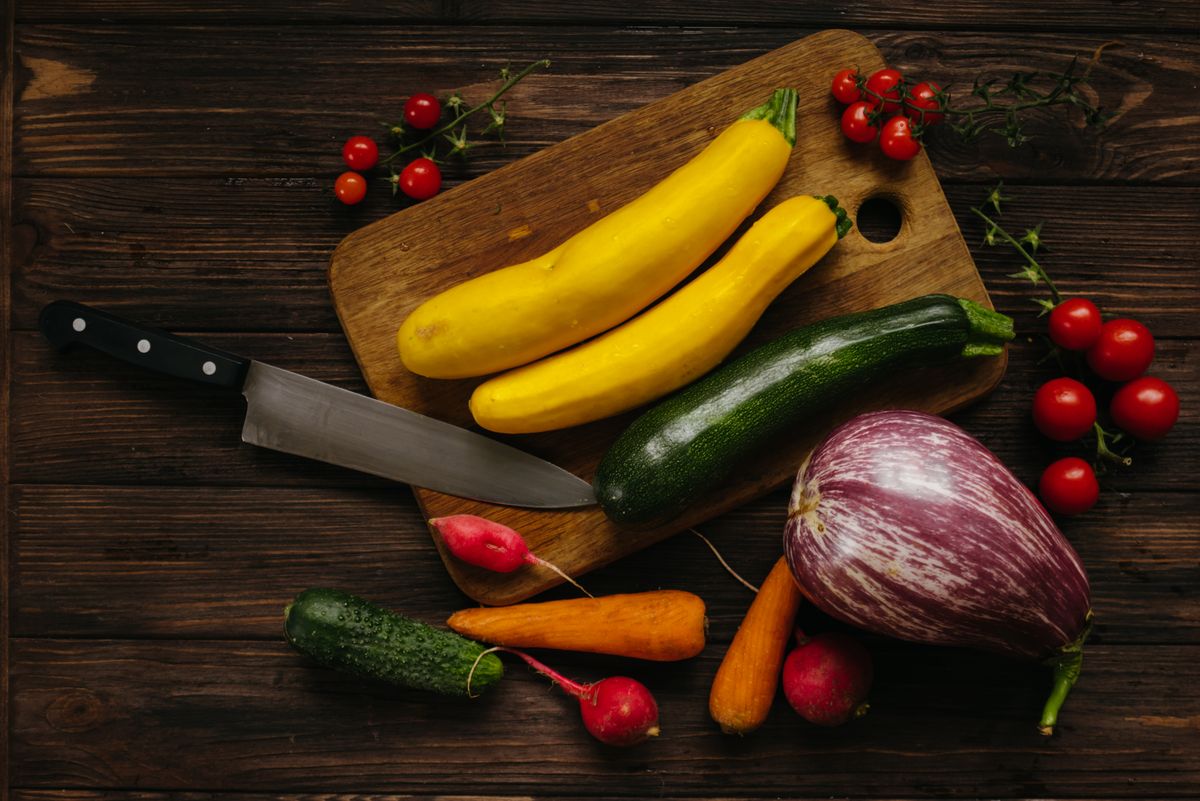
A chopper is not ideal for very soft tomatoes unless the blade is sharp and the tomato skin is not tough. It can crush instead of cut. It is also not my first choice for herbs, leafy greens, very large sweet potatoes, winter squash, or anything so hard that you need to slam the lid.
If you feel the need to use body weight, stop. Pre-cut smaller pieces. Hard vegetables should be trimmed into manageable slabs before going through the grid. A chopper is a levered cutting tool, not a hydraulic press.
And yes, sometimes the chef’s knife is faster. If I need half a lemon sliced, a handful of parsley chopped, or one tomato diced, I am not assembling a 15-piece system. The smartest kitchen tool is the one that matches the job size.
Practical checklist: how to decide before you buy
Use this decision framework instead of counting accessories.
Buy a 15-piece chopper if:
- You regularly prep 2 cups or more of vegetables at a time.
- You cook dishes where even pieces matter: soups, eggs, stir-fries, salsa, sheet pans.
- You avoid vegetables because cutting feels tedious.
- You want a catch container to reduce board-to-bowl transfer mess.
- You will actually use the cleaning comb or brush immediately after prep.
- You have drawer or cabinet space for inserts to stay organized.
Skip it or use a knife if:
- You mostly cut one small item at a time.
- You cook lots of herbs, leafy greens, or soft ripe tomatoes.
- You dislike washing multi-part tools.
- You already have strong knife skills and enjoy chopping.
- You do not want to use a hand guard for slicing.
First-use setup checklist
How I would use the Vegetable Chopper Set of 15 for a real week
Here is the workflow I would recommend for someone cooking four weekday meals.
On Sunday, dice two onions, two bell peppers, and a few carrots. Keep the onion separate if you dislike onion odor spreading. Use part for tacos or chili, part for eggs, and part for a quick soup base. Slice cucumber for lunches the day you eat it, because high-water vegetables lose texture faster after cutting.
On a weeknight, use the large dice for potatoes or zucchini if you are roasting. Use smaller dice for anything going into eggs or sauce. Do not try to make every insert earn its keep on day one. Find your three repeat cuts and build habits around them.
That is the difference between a useful set and a clutter purchase. The useful set becomes a repeatable station. The clutter purchase becomes fifteen pieces you wash once and resent.
FAQ
Is a vegetable chopper safer than a knife?
Not automatically. A chopper can keep fingers farther from the cutting edge during dicing, especially when food is pressed with a lid. But slicer and mandoline-style inserts still require a hand guard and full attention. Safety depends on using stable vegetable pieces, avoiding forced cuts, and cleaning inserts without touching the sharp side.
Can I put all 15 pieces in the dishwasher?
Follow the product care instructions for the specific set. In general, I prefer rinsing blade inserts immediately by hand because dishwashers may not remove trapped onion, potato starch, or carrot fibers from tight grid corners. If dishwasher use is allowed, place sharp inserts securely where they cannot rattle or expose blades during unloading.
Why does my chopper crush tomatoes or peppers?
Usually because the vegetable is too soft, too large, or not sitting flat. Tomato skin can resist the blade while the flesh collapses. Peppers have curved walls and hollow centers, so they often need to be flattened or cut into panels first. Use firmer produce, smaller sections, and a decisive even press.
Does chopping vegetables ahead destroy nutrients?
Some nutrients, especially vitamin C, can decline after cutting because more surface area is exposed to oxygen, light, and moisture. But the practical tradeoff matters: if pre-chopping makes you eat more vegetables, it can be a net win. Store cut vegetables cold, covered, and use high-water items sooner for texture.
Bottom line
The honest case for a 15-piece vegetable chopper is not that it replaces skill. It replaces delay.
A knife is still better for tiny jobs, herbs, and delicate produce. But once you cross roughly 2 cups of firm vegetables, the chopper’s container, repeatable grids, and reduced transfer mess start to matter. The most useful kitchen tools are not always the ones professionals admire. Sometimes they are the ones that get an onion, pepper, and carrot into the pan on a Tuesday night.
Sources
- CDC: Adults Meeting Fruit and Vegetable Intake Recommendations
- USDA FSIS: Danger Zone 40°F–140°F
- Consumer Reports: Mandolines Can Slice More Than Vegetables
- PubMed: Knife-related injuries treated in U.S. emergency departments