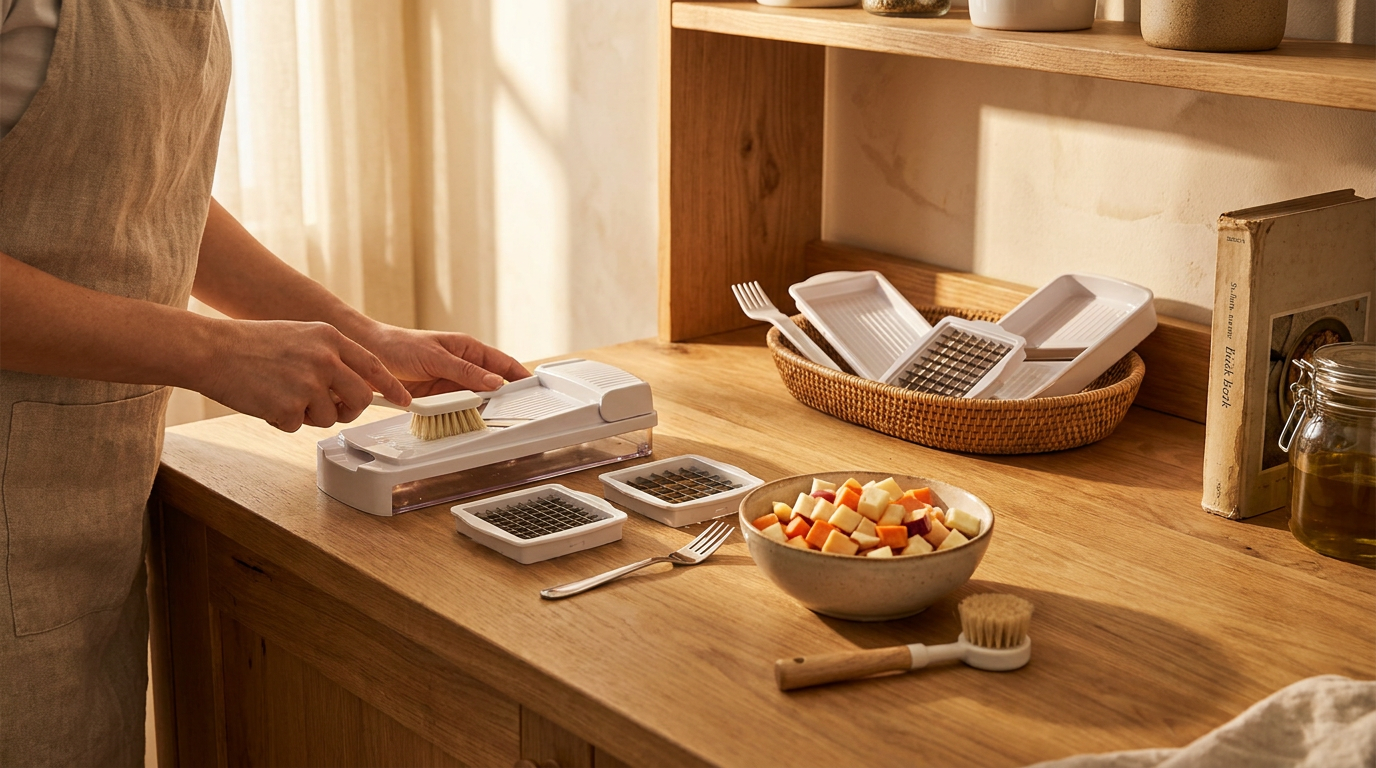
Maintaining the Vegetable Chopper Set of 15 Blade Systems
 Maya ChenContributing Editor
June 9, 2026. This technical overview examines the sanitation requirements and maintenance protocols for high-density kitchen dicing tools. It serves as a resource for home cooks prioritizing hygienic food preparation and equipment longevity.
The Friction Between Efficiency and Sanitization
The conventional wisdom says that more blades necessarily lead to more cleaning frustration, but this view ignores the mechanics of modern polymer construction. In the context of meal prep, the primary bottleneck isn't the physical act of dicing; it is the post-processing residue left in the blade housing. According to The Spruce Eats, many top food choppers mitigate this by ensuring the bowl, blade, and lid are all dishwasher-safe for easy cleaning. However, here's the part nobody talks about: dishwasher safety does not equate to manual debris removal efficiency. When using a spiralizer for zucchini noodles or a sturdy vegetable spiralizer and slicer, the structural integrity of the vegetable fibers determines how deeply they wedge into the stainless steel lattice. Most users rely on high-pressure water, yet the geometry of a pro food chopper slices and dices in a way that requires specific mechanical agitation. The industry consensus is that 'self-cleaning' features are sufficient, but empirical evidence suggests that without a dedicated cleaning tool to clear the pusher teeth, organic matter remains trapped, leading to bacterial growth regardless of the heat cycle in a dishwasher.
Engineering the Vegetable Chopper Set of 15 for Rapid Cleanup

Photo by Gustavo Fring on Pexels
Run the math: a standard knife-and-board setup for a mirepoix takes approximately twelve minutes of active labor, whereas a 15 in 1 vegetable chopper reduces active dicing to under ninety seconds. The Vegetable Chopper Set of 15 addresses the resulting 'cleaning debt' through a modular 15-piece architecture designed for total disassembly. Unlike fixed-blade units, the 15 in 1 vegetable chopper allows for the isolation of the dicing grid. Each of the stainless steel inserts is designed to be ejected from the main frame, exposing the edges that typically collect starch and sugars. When utilizing the sharp blade veggie cutter for potatoes, the primary concern is the accumulation of starch which acts as a biological adhesive. This specific set utilizes a safety lock mechanism that ensures the blade remains stationary during use but facilitates a quick-release motion for rinsing. This design choice directly responds to the high volume of search queries regarding a food chopper with safety lock, as stability is the precursor to both safety and ease of maintenance. By decoupling the cutting surface from the collection bin, the system prevents the cross-contamination often seen in integrated units where the blade cannot be fully submerged or scrubbed.
Criteria for Evaluating Dicing System Hygiene
Selecting a dicing tool based solely on the number of attachments is a common consumer error. The utility of a multipurpose veggie slicer and dicer is found in its material composition and the accessibility of its smallest crevices. To ensure a kitchen gadget for dicing vegetables remains a functional asset rather than a sanitation liability, the following framework should be applied during selection and maintenance:
- Verify the presence of a specialized cleaning claw or brush designed specifically for the pusher plate teeth.
- Confirm that all 15 components are constructed from BPA-free plastics that can withstand high-temperature sanitation cycles.
- Inspect the blade housing for 'dead zones' where water cannot circulate freely during a rinse.
- Assess the ease of the safety lock engagement to ensure the user can comfortably handle the blades during the cleaning process.
- Evaluate the transparency of the collection container to ensure no residue remains in the corners after washing.
Shop Vegetable Chopper Set of 15 here.
Sources

Photo by Gary Barnes on Pexels