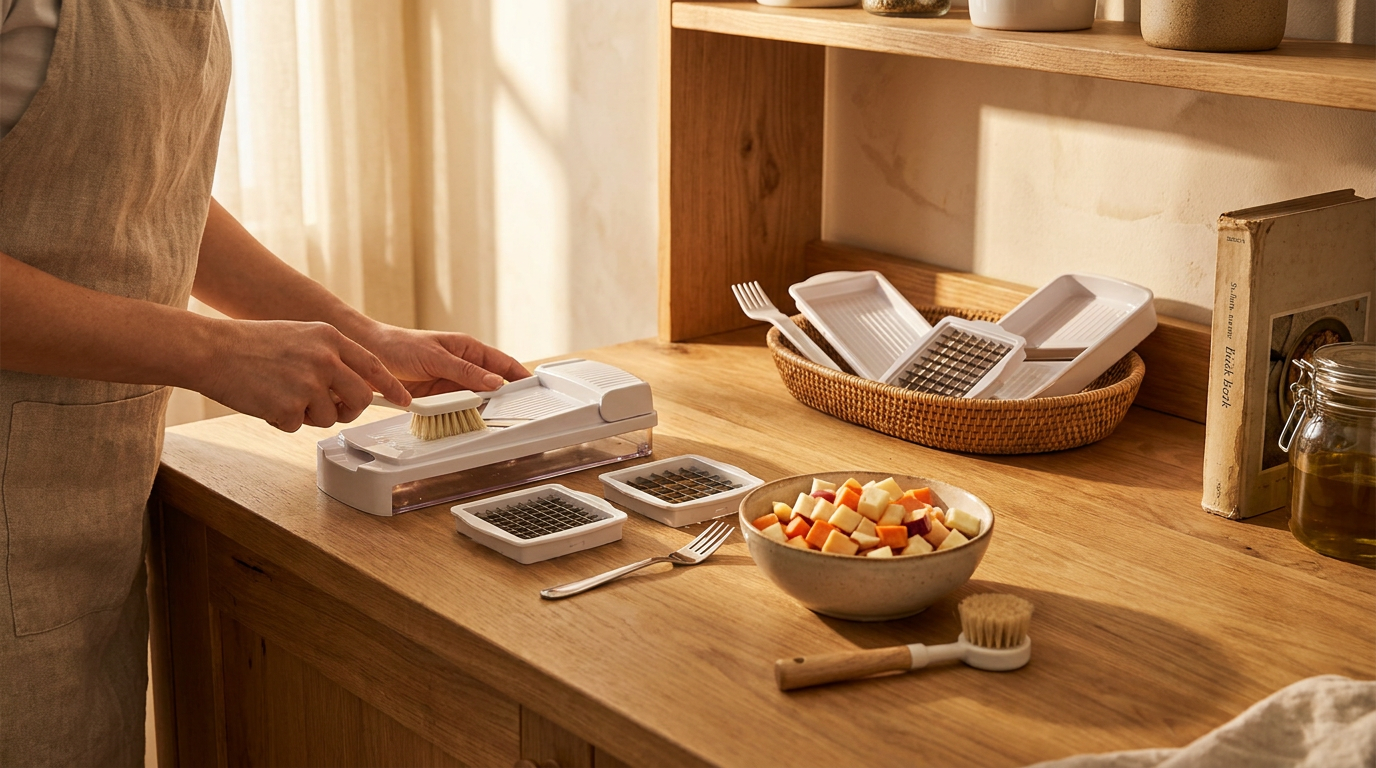
Is the Vegetable Chopper Set of 15 easy to clean?
 Sam VasquezBuying Guide Lead
June 11, 2026 — The Vegetable Chopper Set of 15 is designed for high-efficiency cleaning through its top-rack dishwasher-safe components and specialized cleaning claws, though manual rinsing of the blade grids is recommended immediately after dicing starchy vegetables.
Home cooks often ask about maintenance because a 15-piece set can feel overwhelming. The utility of a multi-blade system depends on how quickly you can transition from a diced onion to a clean countertop.
How does the cleaning process compare to other brands?
The Vegetable Chopper Set of 15 simplifies maintenance with a dedicated cleaning tool for the pusher teeth, a common failure point for simpler models. Compared to competitors mentioned by The Spruce Eats, like basic food choppers where parts are dishwasher-safe, the advantage here is specialized blades that avoid manual scrubbing if rinsed promptly. The Spruce Eats notes that the physical design of the base and lid affects debris entrapment. Between this and a standard dual-blade string chopper, the 15-piece set wins for heavy prep days because the cleaning claw reaches the grid where a sponge cannot. Skip this if you only chop one onion a week; the setup time won't be worth it. The cleaning claw rewards being used correctly, and its technique is worth thirty seconds of instruction the leaflet skims. Work from the underside of the grid, pushing debris up and out the way the food originally entered, rather than picking at the top face — pushing from above only wedges fibers deeper between the teeth. Angle the claw to match the grid's rows and run it along each channel in one continuous pass instead of stabbing at individual squares. Held blade-frame in one hand, claw in the other, a fully packed onion grid clears in under twenty seconds without a fingertip ever approaching an edge.
Guard the claw itself accordingly: it is the one piece of the set with no safe improvised substitute — a fork skids off the grid, and fingers are exactly what it exists to replace — so give it a fixed home clipped inside the collection container rather than loose in a drawer. Owners who lose the claw drift back to risky poking within a week; owners who dock it with the set never think about it again.
Are the blades durable enough for frequent washing?
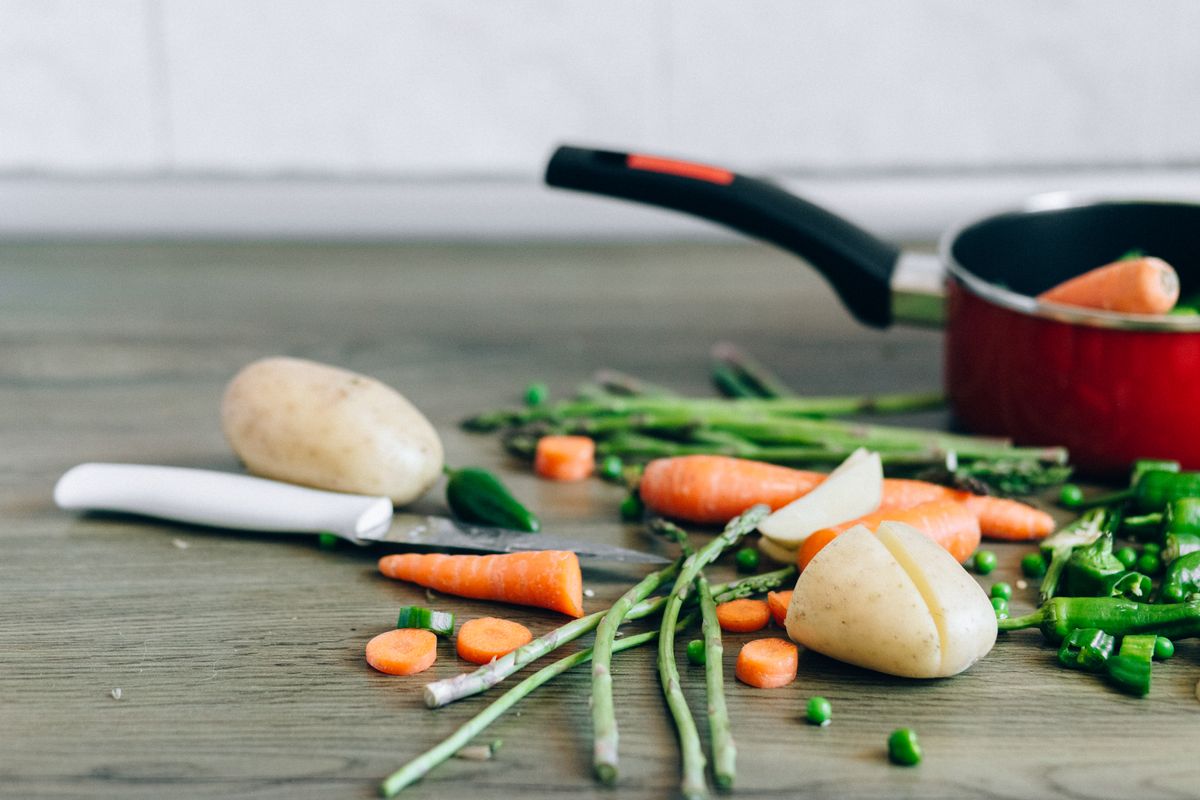
Photo by Nataliya Vaitkevich on Pexels
Yes, the stainless steel blades resist corrosion from frequent water exposure, provided they are dried before storage. Food & Wine testing of multi-blade systems shows that while models with eight or more blades offer versatility, they are difficult to wash by hand if food dries in the crevices. Always utilize the dishwasher for the container and the manual brush for the sharp inserts. Budget single-blade units often lack the structural reinforcement found in this set, leading to warped plastic in high-heat cycles. This 15-piece set’s container-catch system keeps the mess contained and minimizes the scrub area. The households happiest with this set share one workflow habit: cleaning happens during the cooking, not after the meal. The chopping is finished minutes before the stove needs attention anyway — so the rinse slots into that dead time. Dice, tip the contents into the pan or bowl, and rinse the grid and lid under hot water while the oil heats; by the time the onions need stirring, the parts are in the rack and the cleanup debt is zero. Run this way, the after-dinner sink holds only the container, and the set never enters the pile of dishes where multi-part gadgets go to be resented.
The alternative — parts waiting through dinner — is where every complaint in this category is born: starches harden, sugars lacquer, and a twenty-second rinse becomes a five-minute soak-and-scrub. The set is genuinely easy to clean, but only on the schedule its residues dictate; used with the rinse-while-cooking rhythm, "is it easy to clean" stops being a question the owner ever thinks about.
Quick answers
Q: Is every part of the 15-piece set dishwasher safe? A: Most components, including the 1.5-liter collection container and blade inserts, are safe for the top rack. To maintain the stainless steel edge, hand-wash the dicing grids with the provided cleaning claw.
Q: How do you prevent onions from sticking in the dicing grid? A: Use a swift, firm motion when pressing the lid down and use the cleaning tool immediately. For high-sugar vegetables like carrots, a quick cold-water rinse prevents fibers from hardening in the 15-in-1 blade frame.
Q: What happens if the blades become dull after many washes? A: 420-grade stainless steel is designed for longevity. Avoid abrasive scrubbers. If a blade loses its edge, the modular nature of the set allows you to rotate between other dicing or slicing inserts.
For more details, see our guide on Maintaining the Vegetable Chopper Set of 15 Blade Systems or explore the Easy Clean Vegetable Dicer With Blades overview. We also have a deep dive into Easy Clean Vegetable Dicer With Blades performance metrics.
Learn more at https://mandolinechopper.com.
Keep it a produce tool and sanitizing takes care of itself
One policy decision simplifies every hygiene question this FAQ raises: designate the chopper as a produce-and-cooked-foods tool, and never use it for raw meat or poultry. The blade grids, lid teeth, and container corners are exactly the geometry that raw-chicken residue loves and quick rinses miss — the same crevices that make the cleaning claw necessary for onion fibers make genuine sanitization after raw meat a disassemble-everything project. Kept to vegetables, fruit, cheese, and cooked proteins, ordinary hot soapy washing is fully sufficient, and the dreaded cross-contamination scenario simply never arises.
If the rule ever gets broken — a houseguest dices raw chicken in it — the recovery is a full teardown wash of every contacted part in hot soapy water followed by a sanitizing step, not a rinse: either a dishwasher cycle for the dishwasher-safe parts or a brief soak in a standard kitchen sanitizing solution, with the blade grids hand-scrubbed via the claw and brush. That is a fifteen-minute penalty for a two-second shortcut, which is the strongest argument for the produce-only rule staying posted in whatever kitchen shares this tool.
Sources

Photo by Mikhail Nilov on Pexels